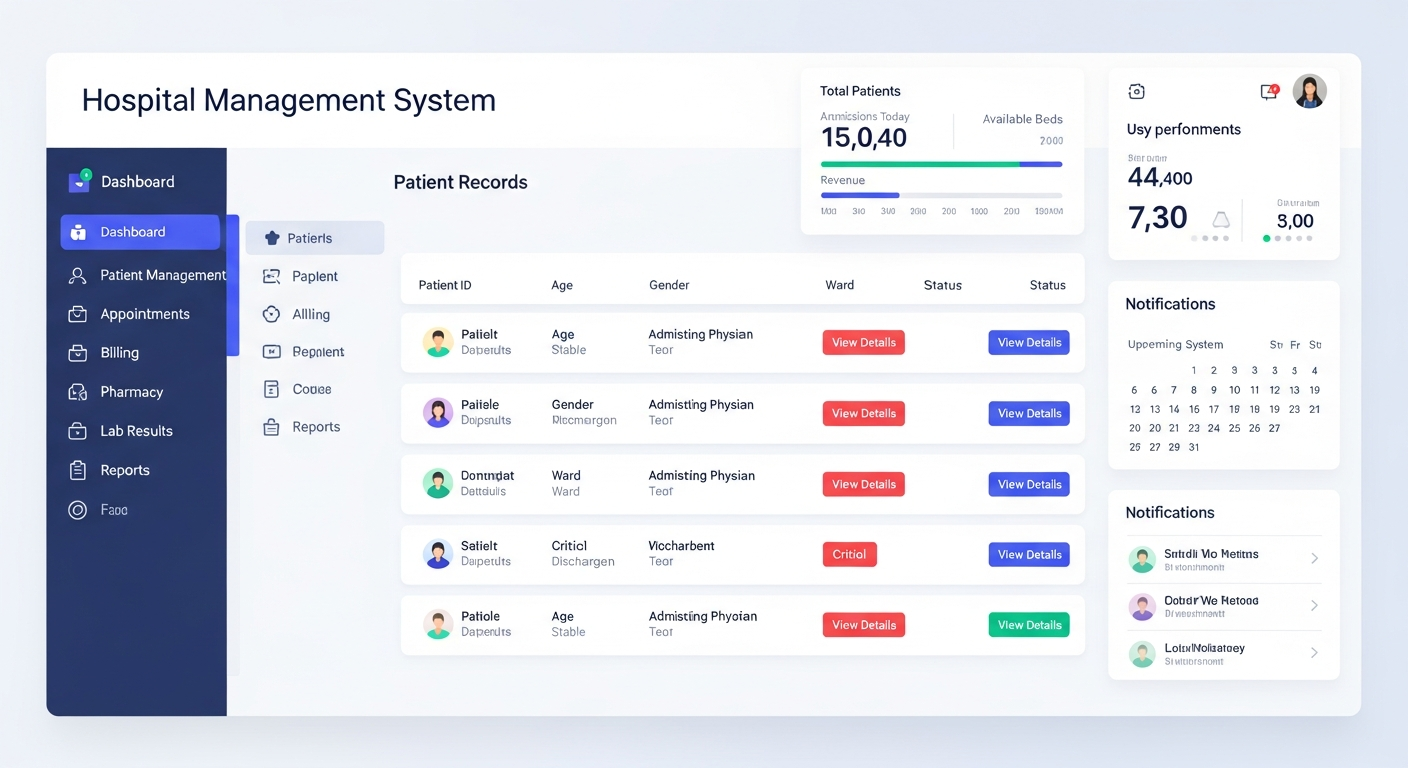
An end-to-end hospital management platform connecting patients, clinicians, diagnostics, pharmacy, billing, inventory, staff, reporting, and secure healthcare data exchange.
Project Overview
MediCare HMS is a centralized, multi-department healthcare management platform designed to coordinate the complete patient journey—from registration and consultation to diagnostics, treatment, billing, discharge, and follow-up. It gives clinical, administrative, and operational teams one reliable source of information while reducing duplicate entry, manual handoffs, and delays in care.
Patient access and engagement
- Patient registration and Master Patient Index (MPI) — creates a unique medical record number and manages demographics, identity documents, contacts, next of kin, consent, and duplicate-record checks.
- Appointment and calendar management — supports doctor schedules, department calendars, recurring appointments, cancellations, reminders, and waiting lists.
- Queue and token management — organizes walk-in and scheduled patients with live queue status by doctor, clinic, or service counter.
- Patient portal and mobile access — lets patients view appointments, prescriptions, reports, invoices, discharge summaries, and approved parts of their medical record.
- Telemedicine and remote consultation — supports virtual appointments, secure clinical notes, digital prescriptions, and follow-up scheduling.
- Patient communication and feedback — manages SMS, email, or messaging notifications, service feedback, complaints, and satisfaction surveys.
Core clinical care
- Electronic Medical Record (EMR/EHR) — maintains longitudinal clinical history, allergies, problems, diagnoses, immunizations, observations, documents, and care episodes.
- Outpatient department (OPD) — manages consultations, vitals, clinical notes, diagnosis coding, orders, prescriptions, referrals, and follow-up plans.
- Computerized Provider Order Entry (CPOE) — enables clinicians to order laboratory tests, imaging, procedures, medication, diets, and other services electronically.
- Clinical documentation — provides configurable templates for histories, examinations, progress notes, specialty forms, certificates, and discharge documentation.
- Nursing station — records assessments, care plans, medication administration, intake and output, handovers, bedside observations, and nursing tasks.
- Medication Administration Record (eMAR) — connects prescribed, verified, dispensed, and administered medicines with time, dose, route, and staff audit history.
- Clinical decision support — can surface allergy, duplicate therapy, drug interaction, abnormal result, and preventive-care alerts according to configured rules.
- Referral and care coordination — manages internal and external referrals, specialist opinions, multidisciplinary care, and continuity between departments.
Inpatient, emergency, and specialized care
- Admission, discharge, and transfer (ADT) — controls admission requests, room assignment, transfers, discharge clearance, and final summaries.
- Ward, room, and bed management — shows real-time occupancy, availability, bed status, isolation requirements, and housekeeping turnover.
- Emergency department and triage — records arrival mode, acuity, triage observations, emergency orders, treatment, disposition, and medico-legal details.
- Operation theatre management — handles surgery requests, theatre schedules, teams, checklists, consumables, operative notes, and post-operative instructions.
- Anaesthesia management — captures pre-anaesthetic assessment, anaesthesia plans, intra-operative observations, medicines, recovery, and complications.
- ICU and critical-care records — supports high-frequency observations, clinical scores, ventilator details, fluid balance, procedures, and critical-care notes.
- Maternity and newborn care — covers antenatal history, labour, delivery, newborn details, postnatal care, and mother–baby record linkage.
- Ambulance and transport management — coordinates requests, dispatch, vehicle availability, crew assignment, trip status, and emergency transport records.
Diagnostics, imaging, blood bank, and pharmacy
- Laboratory Information System (LIS) — manages test catalogues, sample collection, barcodes, worklists, analyser interfaces, validation, critical values, and result delivery.
- Radiology Information System (RIS) — controls imaging requests, scheduling, modality worklists, reporting, approval, and result distribution.
- PACS and DICOM integration — links radiology studies and images to the patient record through standards-based imaging workflows.
- Blood bank management — tracks donors, screening, blood groups, components, stock, cross-matching, issue, transfusion, and traceability.
- Pharmacy management — covers formularies, prescriptions, pharmacist verification, dispensing, substitutions, returns, controlled medicines, and patient instructions.
- Medicine stock and expiry control — tracks batches, serials, expiry dates, reorder levels, transfers, damaged stock, recalls, and near-expiry alerts.
Billing, insurance, and revenue cycle
- Charge and tariff management — configures service prices, packages, doctor fees, room rates, discounts, taxes, and organization-specific tariffs.
- Patient billing and cashier — consolidates OPD, inpatient, pharmacy, laboratory, imaging, and procedure charges into transparent invoices and receipts.
- Insurance and payer management — maintains insurers, plans, coverage rules, network agreements, exclusions, deductibles, and patient eligibility information.
- Pre-authorization and claims — tracks authorization requests, supporting documents, claim submission, responses, rejections, resubmissions, and settlement.
- Corporate and credit billing — supports employer contracts, credit limits, guarantees, consolidated invoicing, and account statements.
- Revenue and receivables — provides payment allocation, refunds, credit notes, outstanding balances, ageing, reconciliation, and collection reporting.
Inventory, procurement, and facility operations
- Central inventory and stores — manages medical and non-medical items across central stores, departments, wards, pharmacies, and satellite locations.
- Procurement and purchasing — supports requests, approvals, quotations, purchase orders, goods receipts, invoices, and procurement history.
- Supplier and contract management — maintains vendor records, price agreements, lead times, performance, documents, and contract expiry alerts.
- Department stock and consumption — links supplies to patients, procedures, departments, cost centers, and replenishment workflows.
- Asset and biomedical equipment management — tracks ownership, location, warranty, calibration, preventive maintenance, downtime, and service history.
- Housekeeping, laundry, and maintenance — coordinates cleaning tasks, linen circulation, room readiness, maintenance requests, and service completion.
- Dietary and kitchen management — translates clinical diet orders into meal plans, production counts, delivery lists, and allergy-aware menus.
Workforce and hospital administration
- Human resources and employee records — manages staff profiles, credentials, contracts, departments, documents, leave, and employment history.
- Doctor credentialing and privileges — records qualifications, licences, specialties, approved procedures, renewal dates, and facility privileges.
- Duty roster and shift management — plans clinical and support staffing, on-call coverage, rotations, attendance, and shift changes.
- Payroll and compensation support — connects attendance, shifts, allowances, deductions, and approved professional fee calculations.
- Role-based dashboards and task management — gives each team the queues, alerts, approvals, workload, and performance information relevant to its responsibilities.
- Multi-facility administration — manages hospitals, clinics, laboratories, pharmacies, departments, users, and shared master data from one platform.
Quality, safety, governance, and records
- Medical records and document management — indexes consent forms, scanned documents, clinical attachments, certificates, and retention-controlled records.
- Infection prevention and control — supports infection surveillance, isolation flags, exposure tracking, antimicrobial review, and outbreak reporting.
- Incident and risk management — records safety events, near misses, complaints, investigations, corrective actions, and follow-up ownership.
- Clinical audit and quality indicators — measures configured care standards, turnaround times, outcomes, readmissions, utilization, and service quality.
- Consent and privacy management — records consent status and applies configurable access restrictions to sensitive information and workflows.
- Audit trails and access control — uses role-based permissions, authentication policies, session controls, and detailed logs of access and data changes.
- Backup, recovery, and business continuity — supports scheduled backups, recovery procedures, availability monitoring, and continuity planning for critical services.
Reporting, analytics, and interoperability
- Operational dashboards — shows patient flow, occupancy, waiting times, departmental workload, stock, revenue, and service status in real time.
- Clinical and management reporting — provides authorized reports for diagnoses, procedures, outcomes, utilization, finance, claims, pharmacy, laboratory, and workforce activity.
- Business intelligence and exports — supports configurable KPIs, trends, drill-down analysis, scheduled reports, and controlled data export.
- HL7 and FHIR interoperability — exchanges patient, encounter, order, observation, medication, and document data with compatible healthcare systems.
- API and third-party integration — connects eligible laboratory analysers, imaging systems, payment gateways, accounting tools, identity services, and communication providers.
- Master data and terminology management — centralizes departments, services, medicines, tests, procedures, diagnosis codes, units, locations, and organization rules.
Platform outcome
The result is a scalable HMS that connects clinical care with the operational and financial work behind it. Authorized teams can follow a patient’s journey, act on current information, and measure performance without maintaining separate departmental records. The modular architecture also allows a clinic, diagnostic center, single hospital, or multi-facility health group to deploy the capabilities it needs and expand over time.