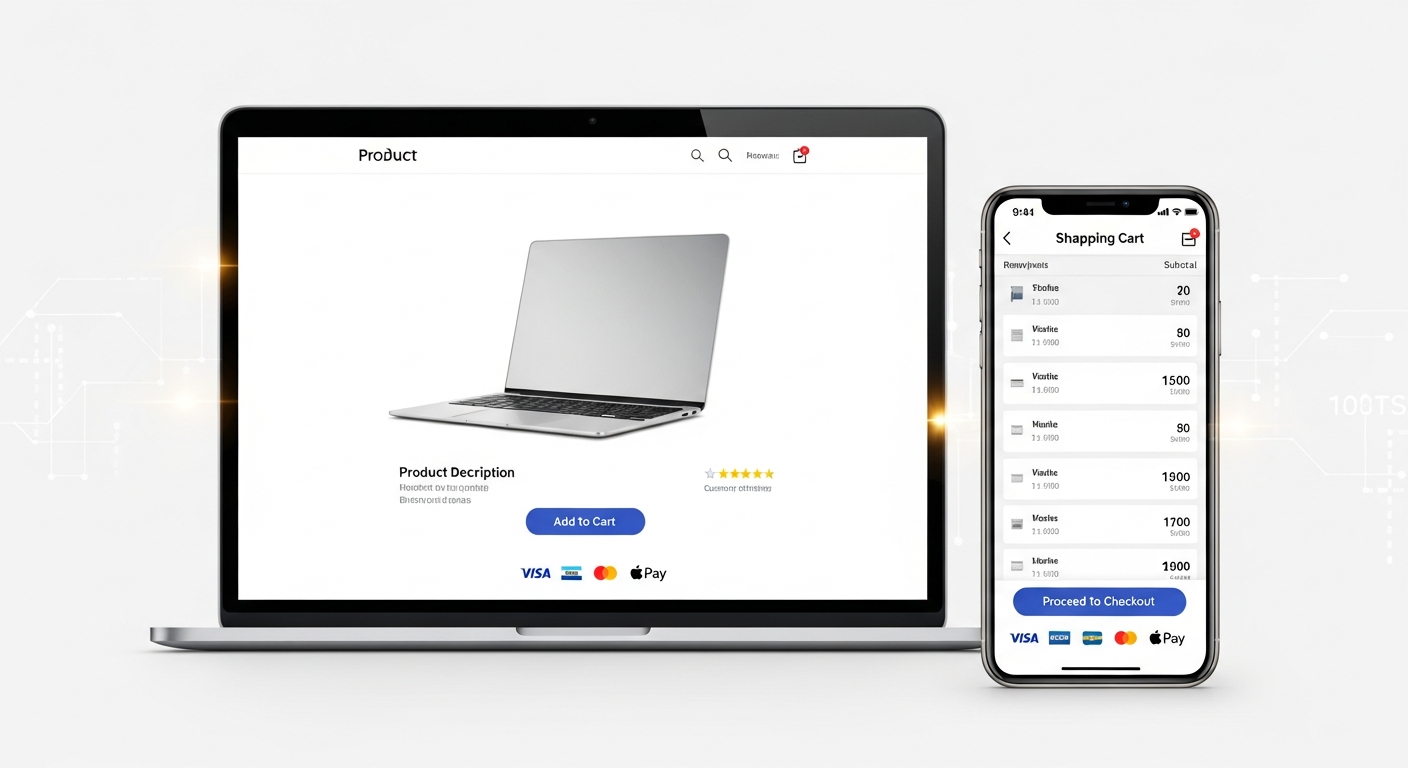
Building the store is about a third of the work. Payments, tax, shipping, stock and returns are the rest. Here are the decisions in the order they actually bite.
Most e-commerce projects are budgeted as though building the store is the work. It is roughly a third of it. The rest is payments, tax, shipping logic, returns, stock accuracy and the operational plumbing that decides whether the business is still functioning six months after launch.
This guide covers the decisions in the order they actually bite, and flags the ones that are expensive to reverse.
Choosing a platform: the real dividing line
The platform question is usually framed as a feature comparison. A more useful frame is how unusual your selling model is.
If you sell physical products with variants, standard shipping and conventional checkout, a hosted platform will do it well and you should resist the urge to build. The work is configuration and design, not engineering, and hosted platforms handle payment security, uptime and compliance updates for you.
Custom development earns its cost when something about your model does not fit that mould: complex configurable products, customer-specific pricing, deep integration with an existing system that owns stock or pricing, subscription logic the platform cannot express, or regulatory requirements in your sector.
The mistake worth avoiding is choosing a flexible platform because you might need flexibility later. You pay for that option immediately, in build cost and ongoing maintenance, and most businesses never exercise it.
Questions that separate platforms usefully
- What are the total transaction costs, including platform fees on top of payment processing?
- Can it handle your tax situation — the places you sell into, digital versus physical goods, business customers with tax exemptions?
- Does it integrate with your accounting and, if relevant, your stock system without manual export?
- What happens if you outgrow it? Can product, customer and order data be exported in a usable form?
- Who is responsible for security updates, and how quickly are they applied?
That last question is the one people forget on self-hosted platforms, where the answer is "you are", and neglecting it is how stores end up compromised.
Product data is the foundation
Everything downstream depends on product data being structured properly, and it is very tedious to restructure once you have a thousand products and live orders.
Decide early how variants work, because getting this wrong is the most common structural error. A t-shirt in three colours and five sizes should be one product with fifteen variants, not fifteen products. That distinction affects your URLs, your stock tracking, your reporting and how the products appear in search results.
Beyond that: consistent attributes that customers actually filter by, real descriptions rather than manufacturer boilerplate that appears on fifty other sites, and images shot to a consistent standard with correct dimensions set so the page does not jump as they load.
Checkout is where money is lost
Abandonment concentrates at predictable points, and most of them are self-inflicted.
Forcing account creation before purchase is the classic one — offer guest checkout and invite registration after the order is placed. Surprise costs are the other major cause: shipping charges revealed only at the final step reliably lose customers who were otherwise ready to buy. Show delivery cost, or at least a clear indication, before the last screen.
Beyond that, ask only for the fields you genuinely need, keep the number of steps low and show progress, offer the payment methods your customers expect including the digital wallets that skip form filling entirely, and make error messages specific about which field is wrong and why.
Test the whole flow on a mid-range phone on a mobile connection, not a desktop on office broadband. That is where most people will actually attempt to buy from you.
Payments, and the compliance you cannot avoid
Use a payment provider that keeps card data off your servers — hosted fields or a hosted payment page. Handling card details directly moves you into a substantially heavier compliance obligation with no benefit to you. Our web security team reviews checkout and payment configurations where compliance obligations are in question.
Two things to plan for that are frequently missed. Strong customer authentication requirements mean some transactions will need an additional verification step; your checkout must handle that gracefully rather than appearing to fail. And you will need a clear process for refunds and chargebacks, including who is authorised to issue them and how they reconcile against your accounts.
Tax and shipping: unglamorous, expensive to get wrong
Tax rules depend on what you sell, where you sell it and who you sell it to, and they differ for digital goods, for business customers and across borders. This is the area where a short conversation with an accountant before launch prevents a genuinely difficult problem later. Configure it in the platform from the start rather than correcting historical orders.
Shipping deserves an explicit decision rather than a default. Flat rate is simple and predictable but loses money on heavy or distant orders. Live carrier rates are accurate but add a dependency at checkout. Free delivery above a threshold reliably increases order values but must be costed properly. Whatever you choose, publish delivery times honestly — the cost of an over-promised date is a support ticket and a lost customer.
Returns are part of the same system. A clear policy, a simple process and a decision about who pays return postage will shape both your conversion rate and your margin.
Search and navigation inside the store
Visitors who use site search convert at a noticeably higher rate than those who browse, because they arrive knowing what they want. It is worth treating search as a feature rather than a box in the header.
The essentials are tolerance for misspellings, synonyms for the words customers actually use rather than your internal terminology, filters that reflect how people choose in your category, and a useful no-results page that suggests alternatives instead of a dead end. Review your site search logs regularly: they are the clearest available list of things customers want and cannot find.
Performance, because it converts
Product and category pages are usually the heaviest pages on an e-commerce site and the most commercially important. The three thresholds that matter are Google's Core Web Vitals — Largest Contentful Paint at or below 2.5 seconds, Interaction to Next Paint at or below 200 milliseconds, and Cumulative Layout Shift at or below 0.1.
The usual culprits are unoptimised product imagery, a stack of marketing and analytics tags, and layout that shifts as prices and stock badges load. Set explicit dimensions on product images, prioritise the main product image rather than lazy-loading it, and audit your third-party scripts periodically. Our website speed guide covers the diagnosis in detail.
SEO for stores
Two structural issues cause most e-commerce search problems.
The first is duplicate content from filters and sorting, where the same products appear at dozens of URL variations. Use canonical tags to point variations at the main category page, and decide deliberately which filtered combinations are worth indexing — usually only those people actually search for.
The second is thin product pages using manufacturer descriptions shared across every retailer selling the same item. Original descriptions, genuine specifications and customer reviews are what differentiate the page. Product structured data makes price and availability eligible to appear directly in results.
Category pages are usually the bigger commercial opportunity, because they match how people search. Treat them as landing pages with real introductory content, not just grids. Our SEO team works on category and product page structure specifically, because it is where most stores leave traffic behind.
Frequently asked questions
How much does an e-commerce site cost?
The range is wide enough that any single figure is misleading. What drives it is the number of products and how complex their variants are, whether checkout, pricing or shipping deviate from the standard model, how many systems need integrating, and whether design is templated or bespoke. A store on a hosted platform with a configured theme and straightforward products sits at one end; a custom build integrated with an existing stock system sits far from it.
Hosted platform or self-hosted?
Hosted removes responsibility for security patching, uptime and compliance updates, at the cost of transaction fees and constraints. Self-hosted gives control and lower per-transaction cost, and makes you responsible for maintenance. If nobody on your team will own patching, choose hosted.
How long does a build take?
Most of the elapsed time is not development. Product data preparation, photography, writing descriptions, and decisions about tax and shipping are usually the critical path. Businesses that have their product data ready launch dramatically faster than those that begin assembling it mid-project.
Do we need an app as well?
Usually not at first. A responsive site reaches everyone without an install step. Apps make sense when you have repeat customers who buy frequently and you can justify the cost of maintaining a second platform. We compare the routes in our post on native versus cross-platform development.
What is most often underestimated?
Operations after launch. Stock accuracy, packing, dispatch, customer enquiries and returns are a daily workload that the website does not remove. Stores that struggle usually built something good and had no plan for the fulfilment side.
Before you start
The decisions that are cheap now and expensive later are: how product variants are structured, which system owns stock and pricing, how tax is configured, and whether your platform choice matches how unusual your selling model actually is. Everything else can be adjusted as you learn.
Our web development team builds on both hosted and custom foundations and will tell you which one your requirements genuinely call for — including when the answer is the cheaper option. Get in touch to discuss what you are planning.