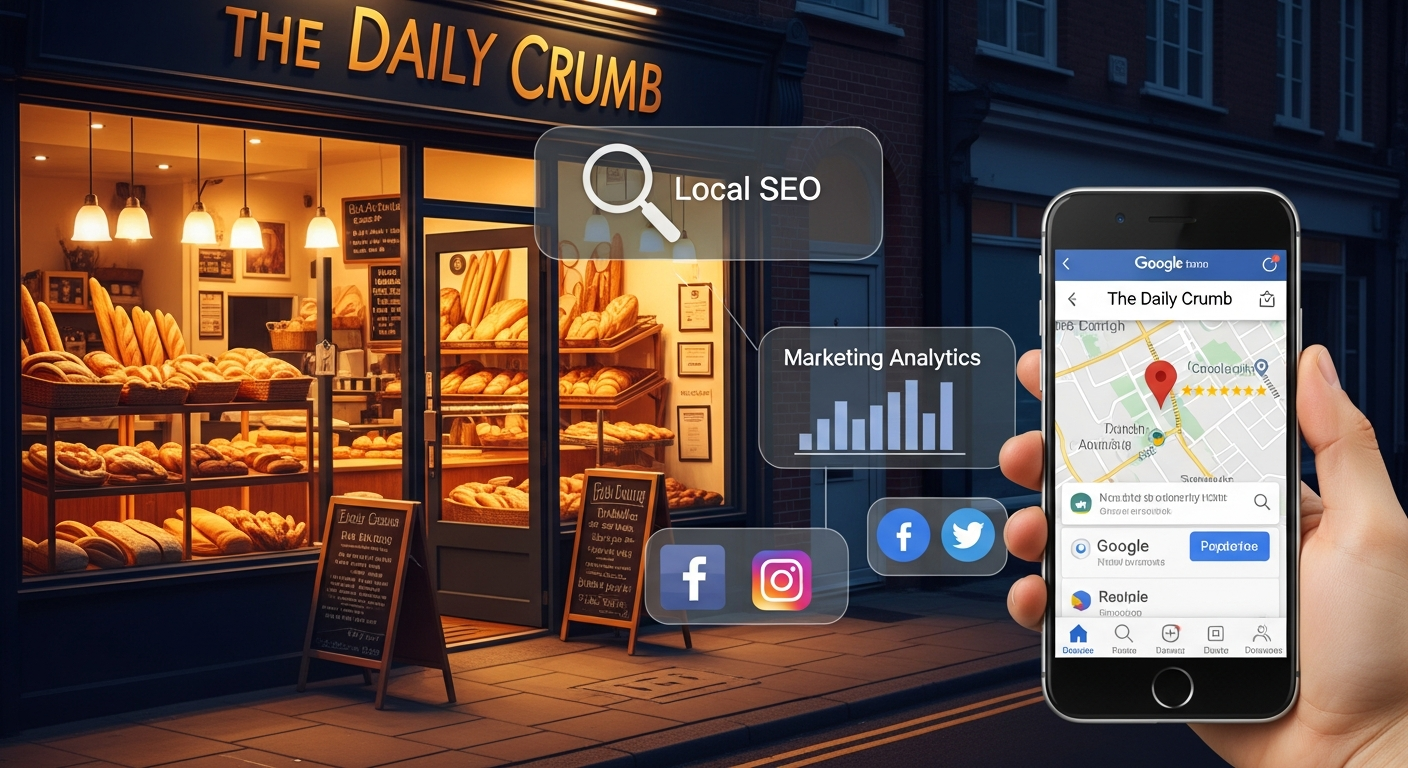
The listing that generates many local enquiries is not your website. It is your Google Business Profile, which is free and often neglected. Here is what moves local rankings.
Local search has an unusual property: the listing that generates many of your enquiries is not your website. It is your Google Business Profile, which is free, sits outside your site entirely, and is frequently neglected in favour of work that matters less.
If you serve customers in a defined area, getting that profile right will do more than any amount of on-site optimisation. Here is what moves local rankings, and what does not.
The three things local ranking rests on
Google describes local ranking in terms of relevance, distance and prominence. That framing is useful because it tells you what you can influence.
Relevance is how well your business matches the search. This is largely under your control through categories, services and content.
Distance is how close you are to the searcher. You cannot change this, which is worth stating plainly: you will not rank in the map results for a city you have no presence in, and no legitimate technique changes that.
Prominence is how well known and well regarded the business is: reviews, mentions, links and general standing. This is where sustained effort pays off.
Understanding the middle one prevents a lot of wasted money. If someone offers to rank you across a whole region from a single location, they are describing something the system is specifically designed not to do.
Your Google Business Profile, properly
Categories are the field that matters most
Your primary category is one of the strongest relevance signals available. Choose the most specific option that describes your main business rather than a broad one that feels safer: "web designer" rather than "marketing agency" if that is what you primarily do. Add secondary categories for genuine additional services, but keep the primary one accurate to your core work.
It is worth checking what categories your competitors who rank well have chosen. This is visible information and frequently instructive.
Complete every field, then keep it current
Google's guidance says businesses with complete and accurate information are more likely to appear in local results, and in our experience complete profiles also convert better. Hours including holiday exceptions, services with descriptions, attributes, a proper business description, and the specific pages on your site that match each service.
Photographs matter more than most businesses expect. Real images of your premises, your team and your work outperform stock imagery, and they are one of the clearest signals to a searcher that the business is genuinely operating. Our graphic design service can help with how those images are prepared and presented across your profile and site.
Consistency of name, address and phone number
Your business details should be identical everywhere they appear: your website, directories, social profiles and professional bodies. Not merely similar. "Street" in one place and "St" in another creates ambiguity that weakens the signal.
Auditing this is tedious and worth doing once properly. Search your business name and phone number and correct what you find, prioritising the larger directories and anything specific to your industry.
Reviews: the part most businesses do badly
Reviews affect both ranking and whether anyone chooses you. Two behaviours separate businesses that do well from those that do not.
Ask consistently rather than in bursts. A steady flow of recent reviews is more valuable than a burst collected in one month and then nothing for two years. Recency matters to readers as well as to ranking. Build the request into the point where a customer is most satisfied, such as job completion, delivery or project sign-off, rather than treating it as a periodic campaign.
Reply to all of them, particularly the negative ones. A measured, specific response to criticism is read by every future customer and frequently does more good than the complaint did harm. Defensive replies do the opposite. Reply to positive reviews too, briefly.
What not to do: incentivising reviews, discouraging negative ones, filtering so that only happy customers are asked, or buying them. Google's review content policy prohibits all of these, and the platforms are considerably better at detecting patterns than most businesses assume.
Your website's role
The profile drives the map results. Your website supports it and captures the searches that produce ordinary blue-link results.
The essentials are a properly built location page with your address, phone number, opening hours, an embedded map and parking or access information; individual pages for each significant service rather than one page listing everything; local business structured data marking up your details; and a website fast enough on mobile that people who tap through actually stay. Our speed guide covers the thresholds that matter.
If you have multiple locations, each needs its own page with genuinely distinct content and its own profile. Building those pages properly, with correct structured data, is work our web development team takes on.
The mistake that gets sites penalised
The most common bad advice in local SEO is to create a page for every town you would like to serve, each identical except for the place name.
These are doorway pages, and Google's spam policies address them directly. They also do not work, because a page with nothing specific to say about a location has nothing to rank on.
The legitimate version is a page per area where you genuinely have something to say: work you have actually done there, customers you actually serve, specific local knowledge. A handful of substantial area pages will outperform dozens of templated ones, and they will not put your site at risk.
Citations and local links
Listings in directories still contribute, mostly through consistency rather than volume. Get the major general directories right, then prioritise anything specific to your industry or locality: trade associations, chambers of commerce and local business groups.
Links from genuinely local sources are more valuable than generic directory listings: sponsoring something local, involvement in a community organisation, local press coverage, partnerships with nearby businesses. These are slower than buying a bulk citation package and considerably more durable.
Measuring it
The Business Profile itself reports how people found you, what they did, calls, direction requests and website clicks. Those actions are closer to real outcomes than rankings.
Be careful interpreting ranking checks. Local results vary substantially by the searcher's exact position, so checking from your office tells you how you rank at your office. Tools that sample across a grid of points give a more honest picture, and the trend matters more than any single reading.
Frequently asked questions
Can we rank in a city where we have no address?
Not in the map results, which are driven substantially by proximity. You can rank in the ordinary organic results for that area with genuinely useful content, and you can serve customers there. Creating a false address is a policy violation and risks losing the profile entirely.
Should we use a virtual office to appear in more places?
No. Google's Business Profile guidelines say a rented mailing address you do not operate from is not eligible, and an office only counts if it is staffed during business hours. Virtual offices and mailboxes are a common reason profiles are suspended, and recovery is difficult.
How long does local SEO take?
Profile improvements can affect visibility within weeks, which is faster than most SEO work. Building review volume and local prominence takes months. It is generally quicker than competing nationally.
What if we serve customers at their location rather than ours?
Use a service-area business profile, which lets you define the areas you cover and remove your street address from the listing. This is the correct configuration for trades and mobile services, and using a standard listing with a home address instead is a common mistake.
Do we need to post updates on the profile?
Posts have modest direct ranking value but do occupy space in your listing and can prompt action. Worth doing if you have something genuine to say; not worth manufacturing content for.
The order to work in
Claim and complete your Business Profile properly, with the most specific primary category. Make your name, address and phone number identical everywhere. Build a consistent habit of requesting reviews and replying to them. Then improve your website's location and service pages.
That sequence produces results faster than most SEO work, because the profile is a direct route to customers who are ready to act. If you would like help with the audit and the ongoing work, our SEO team handles local search alongside the broader technical work covered in our SEO strategy guide. Tell us your area and we will look at your profile first.