Typical website maintenance prices in the US and the UK for 2026, what the monthly fee pays for, and how to tell whether a plan is fair.
If you are trying to pin down a website maintenance cost for next year's budget, the honest answer is that it depends on the site. A small brochure site and a busy online store need very different amounts of work each month, and the price follows the work.
This guide gives the typical monthly ranges for the US and the UK, explains what the money pays for, and shows where our own website maintenance plans sit against those ranges.
The short answer
In the US, website maintenance for a small to medium business site typically costs $50 to $500 a month, according to GoDaddy. UK pricing guides commonly quote about £30 to £300 a month, depending on the plan level. eDeskCloud plans cost $49, $99 or $199 a month (£39, £79 or £159), with no contract.
So how much does website maintenance cost for a site like yours? That comes down to the type of site, the platform it runs on and how much hands-on help you want. The sections below take those one at a time.
Website maintenance cost by type of site
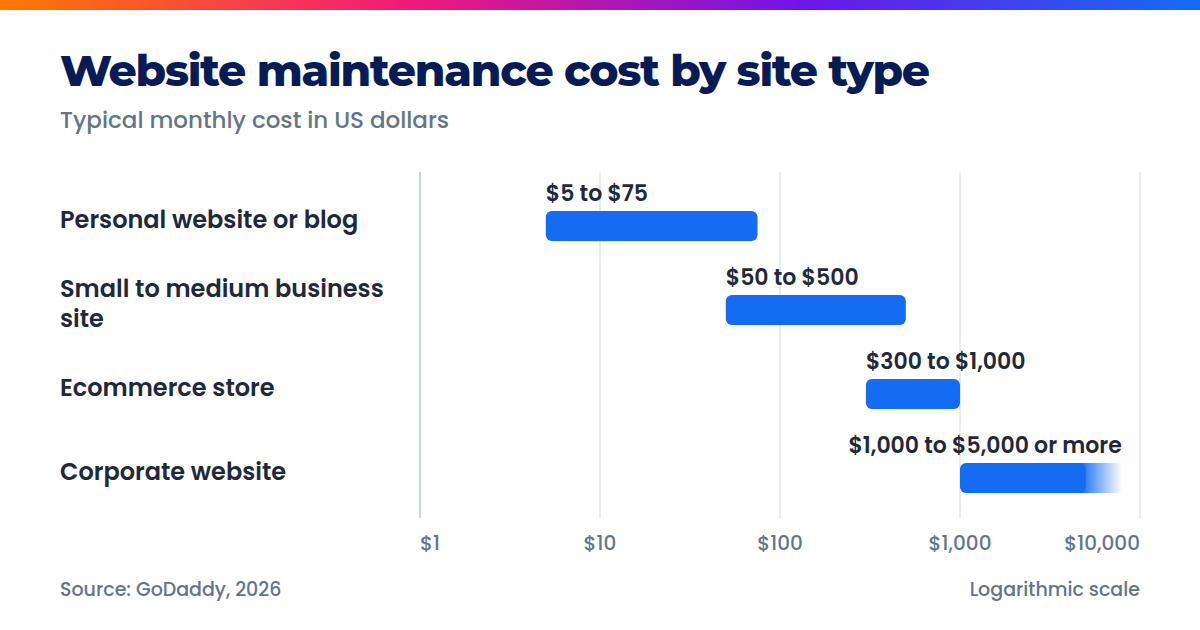
People who ask how much does it cost to maintain a website usually hear "it depends". The type of site is what it depends on most. GoDaddy's 2026 guide gives these typical monthly ranges for the US market.
| Site type | Typical monthly cost (US) |
|---|---|
| Personal website or blog | $5 to $75 |
| Small to medium business site | $50 to $500 |
| Ecommerce store | $300 to $1,000 |
| Corporate website | $1,000 to $5,000 or more |
Source: GoDaddy, How much does it cost to maintain a website in 2026?
The ranges are wide because they cover very different ways of getting the work done. At the low end of a range, the owner is usually doing most of the work with a few paid tools. At the high end, an agency is handling everything and including regular development time.
If you run a small business site, the second row is the one to budget against. That is the typical website maintenance cost per month for a site like yours, and where you land inside it depends on how much of the work you hand over.
Website maintenance cost in the UK
UK agencies and freelancers tend to price maintenance in three levels. UK pricing guides published in 2026 commonly quote the figures below. Treat them as a guide to the market, not as official rates. There is no official rate card for this kind of work.
| Plan level | Typical monthly cost (UK) | What it usually covers |
|---|---|---|
| Basic | About £30 to £75 | Software updates, backups and basic security checks |
| Standard small business | About £75 to £150 | The basics, plus uptime monitoring, more frequent backups and some time for edits |
| Advanced | About £150 to £300 | The standard plan, plus store support, faster response and more hands-on time |
So the typical website maintenance cost per month in the UK runs from about £30 for the basics to about £300 for an advanced plan. Our own UK prices sit inside each level: £39 a month for Essential Care, £79 for Professional Care and £159 for Ecommerce Care.
When you compare website maintenance charges between providers, look at what is included at each level and not only at the headline price. Two plans at the same price can cover very different amounts of work.
What you are paying for
A maintenance fee covers five things. How much of each your site needs decides where you land in the ranges above.
The platform
A hosted platform such as Shopify looks after its own hosting and platform updates, so maintenance is mostly about the theme, the apps and the product data. A self-hosted WordPress or WooCommerce site also needs its core software, plugins and theme kept up to date, which is more work every month.
How often updates are needed
A simple site with a handful of plugins needs fewer updates than a site with a booking system, a membership area and a store. More moving parts means more releases to apply, and more chances for two of them to conflict. That means more testing, and testing is time.
Backups and where they are stored
A backup kept on the same server as the site is lost when the server is. Off-site backups cost a little more to run, and daily backups cost more than weekly ones. What matters most is whether anyone has tested a restore, because a backup that has never been restored is only a hope.
Security scanning and monitoring
Malware scans and uptime monitoring run in the background and raise an alert when something changes. Part of the cost is the tools. The rest is the person who responds when an alert comes in. Real-time monitoring for a store costs more than periodic checks on a brochure site.
Hands-on time for edits and fixes
Most plans include a set amount of time each month for content edits and small fixes. This is often the biggest difference between a cheap plan and an expensive one. Our plans include 30 minutes, 2 hours or 5 hours a month, depending on the plan.
Speed work is a good example of hands-on time. Sites slow down as content and plugins build up, so keeping them fast is routine work and not a one-off job. Our page speed optimization guide explains what that work involves.
WordPress maintenance cost
WordPress maintenance cost is usually higher than maintenance for a hosted platform, for a simple reason: there is more to update.
WordPress core, each plugin and the theme are all released separately, by different developers, on their own schedules. A site with a long list of plugins can have updates waiting most weeks. Each update is small, but any one of them can conflict with something else on the site.
That is why careful providers take a backup before every update and test before it goes live. On our plans, every update run starts with a fresh backup. On Professional Care and above, updates are tested on a staging copy of the site first, so a bad release is caught before your visitors see it.
Plugins are also where most WordPress vulnerabilities appear, so skipping plugin updates to save money is a false economy. You pay for the testing, not for the click on the update button.
A hosted platform such as Shopify applies its own platform updates, which is why a simple Shopify store can need less routine work than a WordPress site of the same size. Its theme, apps and product data still need care.
Annual website maintenance cost for a small business
Monthly prices are easier to compare, but budgets are set by the year. The average annual website maintenance cost for a small business depends on the plan level, so here are the yearly totals for our three plans as a worked example.
| Plan | Per month | Per year (US) | Per year (UK) |
|---|---|---|---|
| Essential Care | $49 or £39 | $588 | £468 |
| Professional Care | $99 or £79 | $1,188 | £948 |
| Ecommerce Care | $199 or £159 | $2,388 | £1,908 |
These totals cover the maintenance work only. Domain renewal, hosting and premium plugin licenses are billed separately by their own providers, so add those to your yearly budget.
There is no contract on any of our plans. The yearly figure is a budget to plan with, not a commitment.
Is a maintenance plan worth it?
Not always. A placeholder site that nobody visits does not need a monthly plan, and we would rather say so than sell you one. If that is your site, you can look after it yourself with our website maintenance checklist.
A site that brings in leads or sales is different. Use this test: if the site went down tonight and stayed down for three days, would it cost you money?
If the answer is yes, a plan is cheaper than the alternative. The alternative is finding out about a broken contact form from a customer, or paying for an emergency clean-up after an update nobody tested.
What a fair plan includes
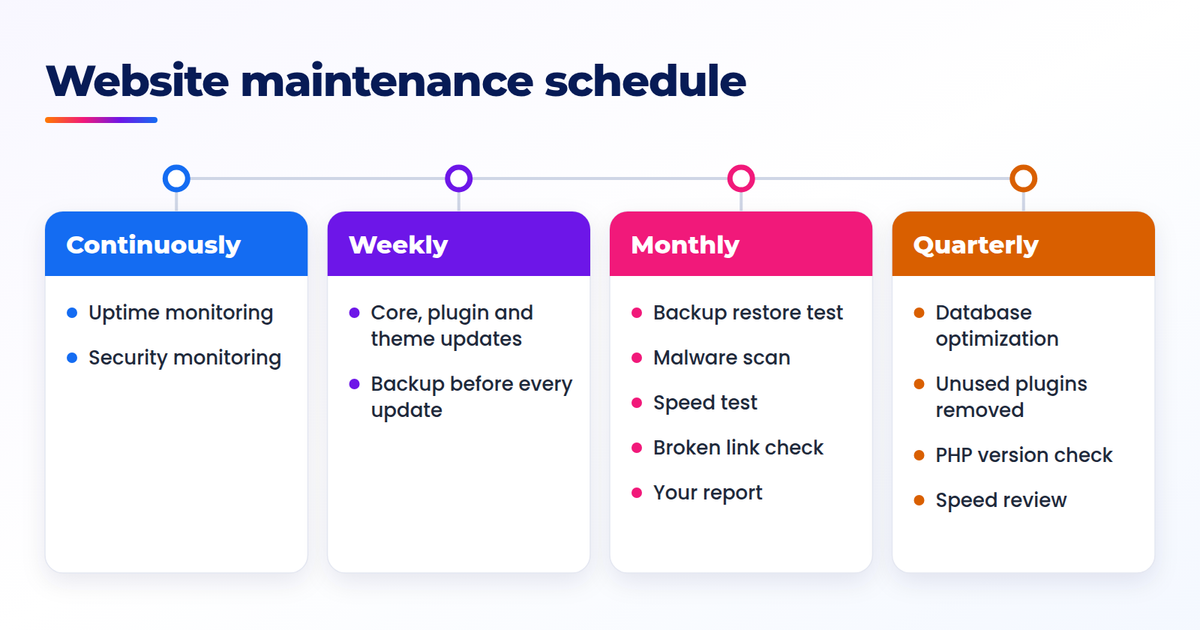
Whatever you pay, a fair plan should include all of these:
- Tested updates, with a backup taken first
- Off-site backups, with restore tests
- Uptime monitoring
- Malware scans
- A monthly report showing what was done
- Included time for small edits
If a quote leaves one of these out, ask why. A plan that skips restore tests or reporting can look cheaper and still cost more when something goes wrong.
For comparison, this is how our three plans cover that list:
- Essential Care, $49 or £39 a month: core, plugin and theme updates, weekly off-site backups, uptime monitoring, security monitoring and malware scans, 30 minutes of included time and a monthly report.
- Professional Care, $99 or £79 a month: everything in Essential Care, with updates tested on staging first, daily backups with one-click restore, speed work and Core Web Vitals, 2 hours of included time and priority support.
- Ecommerce Care, $199 or £159 a month: everything in Professional Care, with real-time uptime monitoring, checkout and payment gateway monitoring, 5 hours of included time and same business day support.
Website maintenance cost FAQ
How much does website maintenance cost per month in the UK?
UK pricing guides published in 2026 commonly quote about £30 to £75 a month for basic maintenance, £75 to £150 for a standard small business plan and £150 to £300 for advanced plans. eDeskCloud plans cost £39, £79 or £159 a month, with no contract.
How much does WordPress maintenance cost?
It depends on how many plugins the site uses and how much hands-on time you want. For a small to medium business site, GoDaddy puts typical maintenance at $50 to $500 a month. Our plans all work as WordPress care plans and cost $49, $99 or $199 a month.
Do I pay for hosting separately?
Yes. Hosting, domain renewal and premium plugin licenses are billed separately by their own providers. A maintenance plan covers the work of looking after the site, not the services the site runs on.
How much does it cost to maintain a small business website per year?
On our plans it is $588, $1,188 or $2,388 a year, or £468, £948 or £1,908 a year in the UK, depending on the plan. Domain, hosting and plugin licenses are extra and are billed by their own providers.
Get a fixed price for your site
Our website maintenance packages start at $49 a month, or £39 in the UK, with no contract. Send us your website address and we will tell you which plan fits, or whether you need one at all.